Eidos

Features

One definition, and every tool reads it.

A canvas, a backlog, a decision log, comments, git, and your own AI agent, built around one idea: every part of what you make is a plain file, shaped by a framework you choose, and every plugin points at those files.

Free for macOS, Windows, and Linux. No account, no subscription.

The model

Everything points at the same file.

  • One markdown file per part of what you make, with a permanent id that survives every rename.
  • Tasks, decisions, canvas nodes, comments, and your agent all point at it by that id, and the file shows them back.
  • All of it lives in one folder you own, plain text, and in git if you use it.
One blueprinta markdown file with a permanent id

The core

Always there

Blueprints

One markdown file per part of what you make, checked against a framework you declare.

  • Typed properties and a permanent id on every file
  • Collections, templates, and properties you choose
  • A health check in the app and in a terminal
The Resume Playback blueprint open in Eidos: its id B-V63 and its path, a one-line summary, typed properties (variant, status, dates, domain, type, and a Depends On link to Profiles), then the body under the template’s headings, Intent, Assumptions, and Open Questions, with the sections listed down the right.
Explore Blueprints

The plugins

Four that change how you work, and the ones that keep it tidy.

On by default

AI Agent

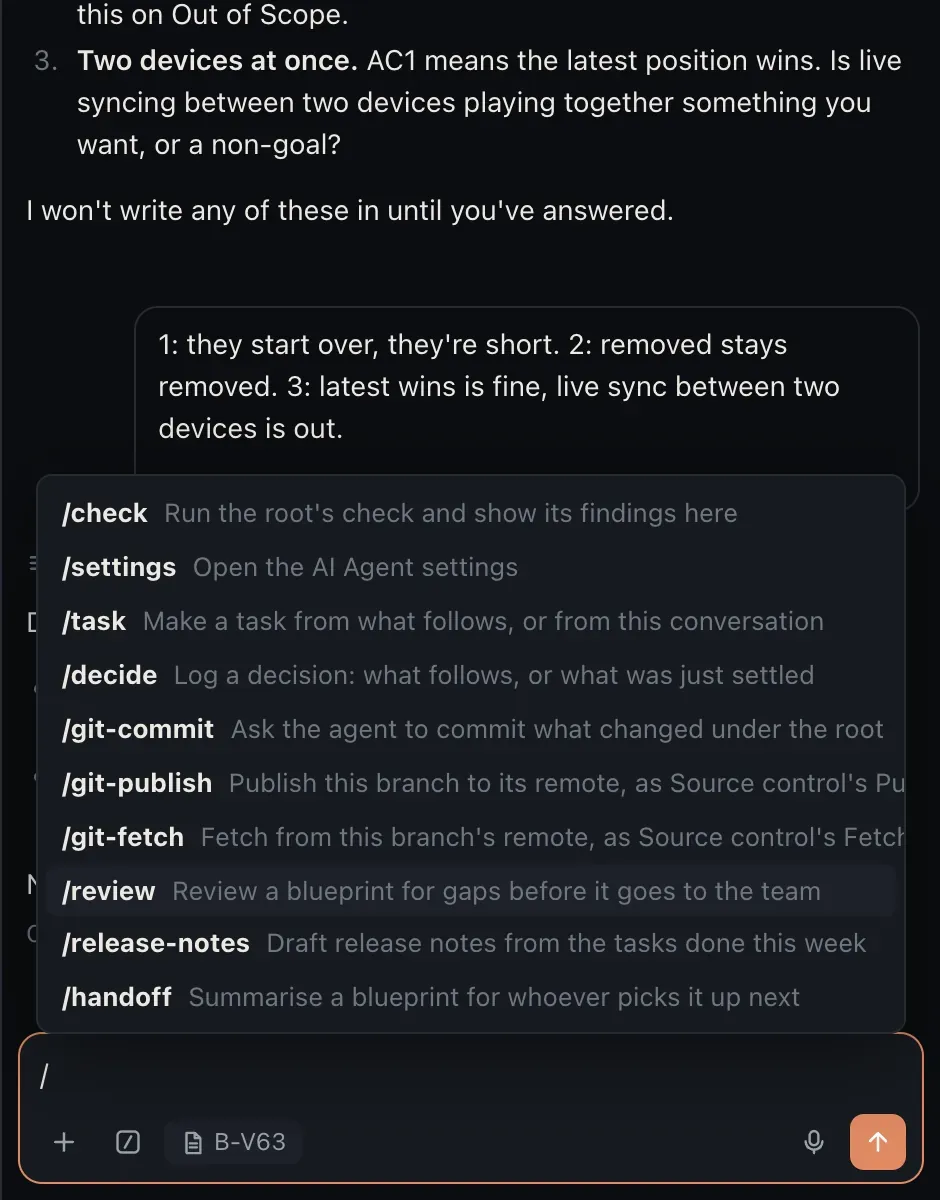
The agent you already run, beside every page, with the page as context and your team’s own slash commands.

  • Claude Code, Codex, or any ACP agent
  • Built-in and custom slash commands
  • /grill asks before anything is written
The AI Agent beside a blueprint with its slash command menu open: built-in commands such as /check, /task, and /decide, the Git plugin’s /git-commit, /git-publish, and /git-fetch, and three commands the team added, /review, /release-notes, and /handoff.
Explore AI Agent
One switch to turn on

Backlog

A board where every task is a markdown file, pointing at the blueprint it serves.

  • Your statuses, columns, types, and priorities
  • Subtasks, links, and checklists
  • Attached tasks beside every blueprint
The backlog board with To Do, In Progress, In Review, and Done columns. Each card shows its type icon, its id, its priority, who it is assigned to, and the blueprint it serves.
Explore Backlog
One switch to turn on

Canvas

A whiteboard whose nodes are your blueprints, drawn live from their files.

  • Nodes drawn live from your files
  • Sketches promoted into blueprints
  • Frames, flows, stickies, and pages
A canvas for a streaming app: blueprints grouped into Getting in, Finding a film, and Watching, joined by labelled arrows, each node edged in the colour of its status, with two sticky notes and a sketch.
Explore Canvas
One switch to turn on

Decisions

A decision log where every call waits for a named person to confirm it.

  • An inbox of what waits to be confirmed
  • Agents log as themselves, people confirm
  • Written into the blueprint it was made for
The Unconfirmed decisions inbox with three decisions waiting, each with its type icon, its id, a Proposed status, Maya Okafor as the person it waits on, the blueprint it was made for, and who logged it: two by Claude, one by Maya Okafor. The sidebar counts Unconfirmed and Assigned to me, by status and by type.
Explore Decisions
On by default

Comments

Threads anchored to a section, with reactions, written into the file.

Explore Comments
On by default

Git

File history, diffs, commit, and publish, without a terminal.

Explore Git
One switch to turn on

Assets

Images and PDFs linked to the blueprints they belong to.

Explore Assets
On by default

Linter

One markdown style for the whole root, applied on every save.

Explore Linter
One switch to turn on

Terminal

Your own shell in the panel, started in the root.

Explore Terminal

Only what you need

Every plugin is a switch.

Switching a plugin off leaves your files exactly as they were. A new root starts with the AI Agent, Comments, Git, and the Linter on; the Backlog, the Canvas, Decisions, Assets, and the Terminal are one switch away under Core plugins.

The Eidos plugin settings: Canvas, Backlog, AI Agent, Comments, Decisions, Assets, Git, and Linter switched on, and the Terminal off, each with a line on what it does.

Works with what you use

Your agent, your repository, your editor.

  • Your agentClaude Code, Codex, or any agent that speaks the Agent Client Protocol, signed in with your own account.
  • Your git hostGitHub, GitLab, or anywhere git pushes. Eidos commits, pulls, and publishes; the repository stays yours.
  • Your editorOpen any file in VS Code, Cursor, Zed, or whichever editor you list, and the page follows the change.
  • ObsidianExport a canvas as JSON Canvas, bring an Obsidian theme, or lay the ACE framework over a vault.
  • SpreadsheetsExport a collection or the backlog as CSV or an Excel workbook.

Why it is different

The part underneath is what nobody else ships.

Other apps have a canvas, a board, or an agent panel, and a few have all three. What Eidos adds is underneath: every unit is a markdown file checked against a framework you declare, served by a backlog and a decision log a person confirms, with frameworks you can share through a Registry, in one free, local app.

Eidos for…

Find the page written for you.

Each one starts from your problem, shows the framework to install, and the plugins that matter most for your work.

Write down what you’re making.

Download Eidos MD, open a folder, and start from the framework closest to your work. Everything it gives you can be reshaped later.

Free for macOS, Windows, and Linux. Your files stay plain text in a folder you own.